
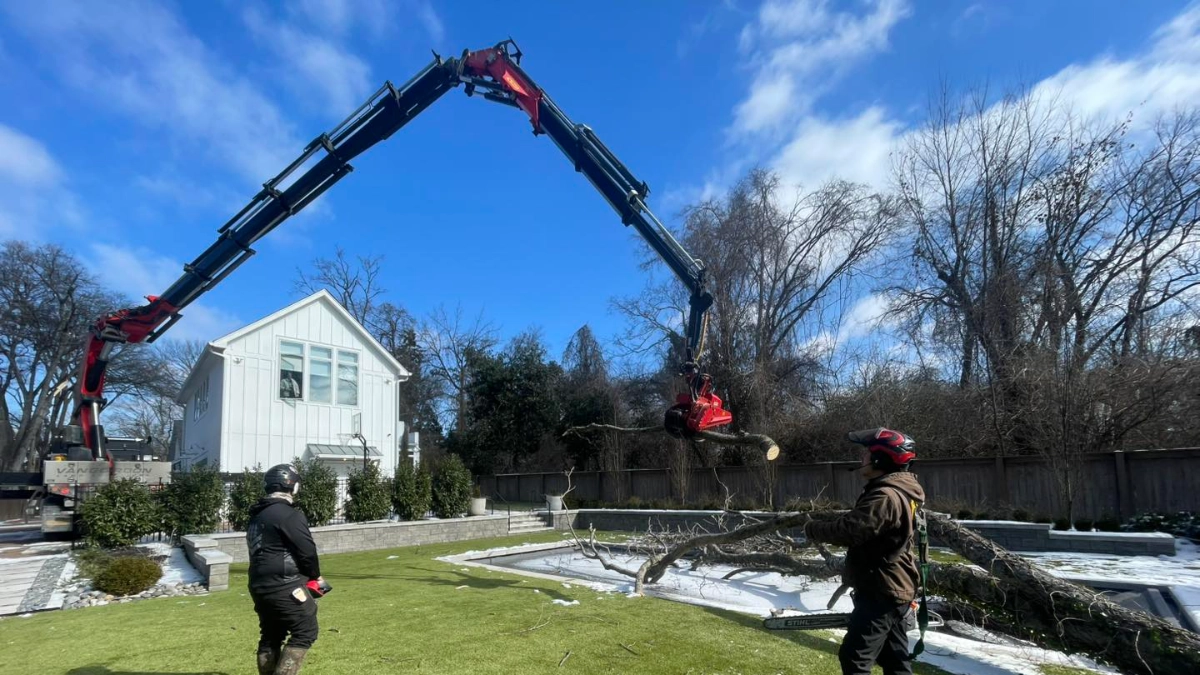
Not every tree comes down the same way. Some trees can be climbed, cut in sections, and lowered with ropes. But others, especially the big white oaks and silver maples that have been growing in Highland MI backyards for 80 or 100 years, need something more powerful. Crane tree removal in Highland MI is one of those services most homeowners don’t think about until they’re standing in their yard looking at a 90-foot tree that’s leaning toward their roof. That’s when the right equipment makes all the difference between a clean job and a disaster.
What Makes a Tree Removal “Difficult” in the First Place
Here’s the thing about tree removal: it looks simple until it isn’t. A tree growing out in an open field is a completely different job than a tree wedged between a house, a fence, and a detached garage with power lines running overhead. The variables multiply fast, and standard removal methods don’t always give crews enough control to protect what’s around the tree.
Size is the most obvious factor. A tree with a trunk diameter over 24 inches and a canopy that’s spread 40 or 50 feet wide can’t just be felled like a forest tree. There’s too much mass and too little room. In Southeast Michigan, especially in older neighborhoods around White Lake, Milford, and Commerce Township, you’ll find mature trees that were planted decades before the homes around them were even built. Those trees are now enormous, and they’re surrounded by structures on every side.
Lean direction matters just as much as size. A tree that’s naturally leaning toward a house or garage is what crews call a “problem lean.” You can’t just notch it and let it fall. The physics work against you, and ropes and rigging alone may not give you enough control. Add in a compromised root system or internal decay, and you’ve got a situation where traditional climbing and cutting simply aren’t safe enough.
Signs Your Tree Needs Crane-Assisted Removal
There are five situations where crane tree removal is usually the right call. Knowing them ahead of time can save you a lot of stress and money.
First, if you have a large tree sitting close to your house, that’s the clearest sign. We’re talking trees within 15 to 20 feet of a structure, especially when there’s no clear felling zone. In Highland and White Lake, a lot of homes sit on wooded lots where the trees grew right up next to the foundation over the years. Removing those trees without a crane means a lot of rigging, a lot of risk, and a much longer job. The crane lets crews lift sections straight up and away from the structure cleanly.
Second, trees over garages and driveways are tricky. The canopy hangs over something you can’t afford to damage, and dropping sections from height is not an option. Third, storm-damaged trees are some of the most dangerous removals there are. After a major storm comes through Oakland County or Livingston County, you’ll often find trees that are split, hanging in other trees, or sitting at a dangerous angle with tension built up in the wood. That tension can cause a log to kick unpredictably when cut. A crane removes that tension by supporting the weight before the cut is made. Fourth, tight access situations where equipment can’t get close to the tree make traditional removal extremely difficult. And fifth, any tree over 60 feet tall in a confined space is almost always a crane job. There’s just too much material to manage safely without mechanical lift.
How Crane-Assisted Tree Removal Actually Works
VanGordon Tree & Land Solutions operates a 110-foot crane, which gives crews the reach to handle even the tallest trees in Southeast Michigan. The process is more coordinated than most people expect. It’s not just swinging a crane hook at a tree. It takes planning, communication, and a crew that knows exactly what they’re doing at every step.
Before the crane ever arrives, the team walks the property during the free estimate and maps out the job. They’re looking at the tree’s height, lean, and condition. They’re also looking at the ground, because a crane needs a stable setup point. (You might not realize how much planning goes into positioning the crane before a single cut is made.) Once the crane is in position, a climber goes up and attaches rigging straps to sections of the tree. The crane takes the weight, the climber makes the cut, and the crane lifts that section out and sets it down in a controlled landing zone.
This process gets repeated section by section from the top down. Each piece is lowered with precision. That’s what protects your roof, your fence, your driveway, and your lawn. VanGordon’s crew doesn’t just drop sections and hope for the best. Every lift is controlled, and every landing is planned. That’s the difference between crane tree removal and a crew that’s just guessing.
Why Crane Removal Is Safer Than Traditional Methods for Complex Jobs
There’s a reason professional arborists recommend crane removal for difficult jobs. It’s not about having fancy equipment. It’s about controlling every variable you can control. Traditional removal with ropes and rigging works great on the right trees. But on large, dangerous, or tightly positioned trees, the margin for error shrinks fast.
With a crane, you eliminate the need to let sections free-fall. That means less impact on the ground, less chance of a bouncing log damaging a fence or punching through a deck. It also means less stress on the crew, because they’re not fighting the weight of the tree with ropes alone. Difficult tree removal jobs in Southeast Michigan, especially after ice storms or wind events that come through Livingston County every winter, often involve trees that are structurally compromised in ways that aren’t visible from the outside. The crane adds a layer of control that protects everyone.
VanGordon’s team is DOT-screened and drug-tested, and Justin VanGordon is personally involved on every job. That matters when you’re talking about a crane swing over your house. You want to know exactly who is on that crew and what their standards are. With 18-plus years of service across Southeast Michigan and over 200 five-star Google reviews, VanGordon has built a reputation on doing this kind of work right.
The Cost Question: Is Crane Removal More Expensive?
Honestly, yes. Crane tree removal does cost more than a standard removal. You’re paying for specialized equipment, a larger crew, and more planning time. But here’s what that comparison is really about: the cost of crane removal versus the cost of damage.
A large tree section dropped incorrectly onto a roof in Highland, Milford, or Walled Lake can cause tens of thousands of dollars in structural damage. A fence can be replaced for a few thousand dollars, but a damaged garage roof or a crushed HVAC unit is a much bigger problem. When you weigh the cost of doing the job right against the cost of a bad removal, crane removal almost always comes out ahead on complex jobs. VanGordon provides free estimates, and during that walkthrough they’ll tell you honestly whether a crane is necessary or whether a less expensive method will work safely. There’s no upselling here. If a crane isn’t needed, they’ll say so.
VanGordon also assists with insurance claims for storm-related removals. If a tree came down in a storm and damaged your property, that’s often a situation where your homeowner’s insurance may cover some or all of the removal cost. The team can work directly with your adjuster and help document the damage properly.
Why Highland MI and Southeast Michigan Homeowners Trust VanGordon for Crane Tree Removal
VanGordon Tree & Land Solutions has been serving Highland MI and the surrounding communities since 2007. That’s over 18 years of working on properties across Oakland County, Livingston County, and beyond. Justin VanGordon started this company as a family business and has kept it that way. Every job gets his direct attention. That’s not a marketing line. It’s how they operate.
The credentials back it up. VanGordon is a member of the Tree Care Industry Association and the International Society of Arboriculture. The crew is licensed, insured, and DOT-screened. The 110-foot crane is one of the most capable pieces of equipment in the region for large tree removal near houses, difficult tree removal situations, and any job where precision matters. They serve Brighton, Milford, White Lake, Howell, Commerce Township, Fenton, Holly, Wixom, Hartland, Pinckney, Whitmore Lake, Walled Lake, and all the communities in between.
And when a storm comes through and you need help fast, VanGordon offers 24/7 emergency response. Because crane tree removal in Highland MI and the rest of Southeast Michigan doesn’t always happen on a scheduled weekday. Sometimes a tree comes down at midnight and you need a team that answers the phone.
If you’re looking at a large tree near your home and you’re not sure what it’s going to take to remove it safely, reach out to VanGordon Tree & Land Solutions for a free estimate. Justin and his team will walk your property, give you an honest assessment, and let you know exactly what the job requires. Visit vangordon.com to get started.