
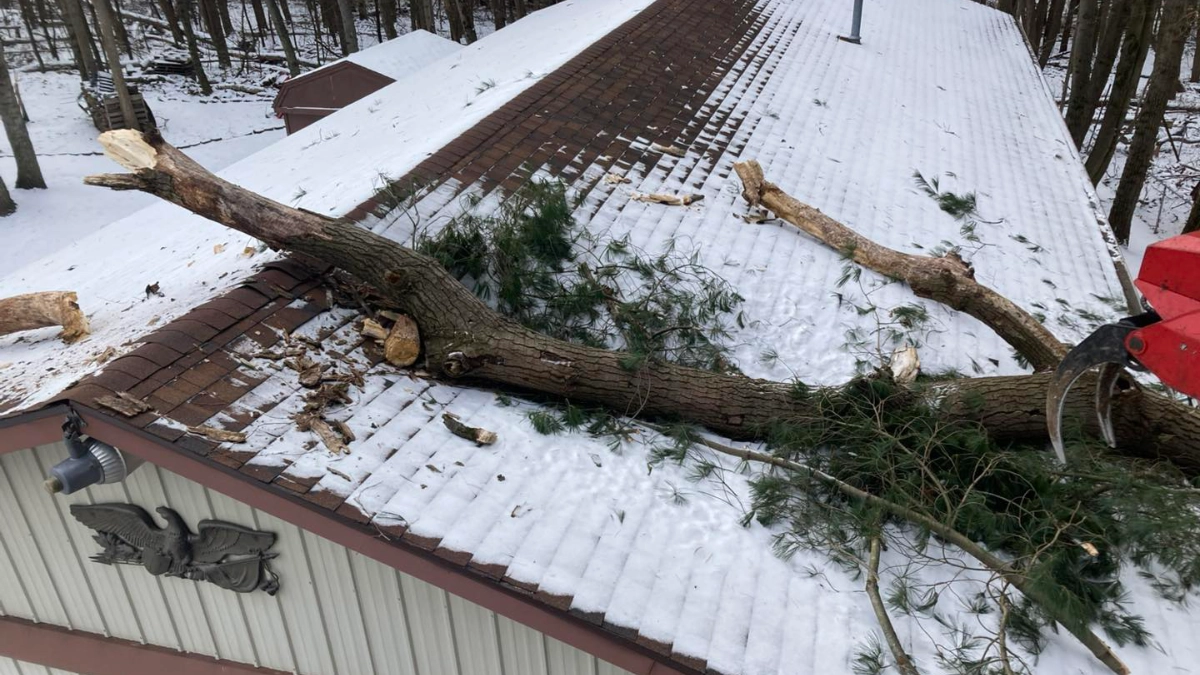
Southeast Michigan doesn’t mess around when it comes to summer storms. If you’ve lived in Highland, Milford, or anywhere across Livingston and Oakland Counties for more than a season, you know exactly what we’re talking about. Derecho-style winds, heavy rain, and the occasional lightning strike can do a number on the trees in your yard, and not all of that damage is obvious the next morning. That’s why storm damaged tree removal in Highland MI is one of the most common calls VanGordon Tree & Land Solutions handles every summer, often days after the storm has passed and homeowners realize something isn’t right.
Why Michigan Summer Storms Cause Hidden Tree Damage
Michigan’s summer storm season runs from roughly May through September, and the storms that roll across Oakland and Livingston Counties can be intense. Wind gusts from a strong thunderstorm cell can hit 60 to 70 miles per hour, which is enough to crack root systems, split branch unions, and tear bark away from the cambium layer without the tree visibly falling over. The tree looks fine from your back door. But it isn’t.
Root saturation is a big part of the problem here in Southeast Michigan. When heavy rain soaks already-wet soil, large trees can lose their grip on the ground. Roots that were holding firm before the storm may have shifted, cracked, or partially pulled free without the tree actually falling. You might notice a slight lean that wasn’t there before, or a small mound of soil near the base. That’s your first clue something has changed underground.
Lightning strikes are another source of hidden damage that homeowners often miss. A lightning bolt traveling through a tree can cause internal wood failure while leaving only a thin scar or a strip of missing bark on the outside. The tree may leaf out normally for another season before it fails without warning. Which is why a visual check from the ground after every major storm is worth your time, even if your trees look fine at first glance.
7 Warning Signs of Hidden Storm Damage You Should Check For
Here’s the thing, you don’t have to be an arborist to spot the early warning signs of storm damage. You just have to know what to look for. Walk around your property after any significant storm and keep an eye out for these seven things.
First, look for hanging limbs. A branch that’s been partially broken but is still attached to the tree is called a “widow maker” for a reason. It can drop at any moment, and the weight of a single large branch from a mature red oak or silver maple can cause serious injury or property damage. Second, check for bark cracks or splits along the trunk or major branches. Fresh cracks often appear after wind events and can indicate internal splitting that goes much deeper than the surface. Third, look at the base of the tree for any heaving or mounding of the soil, which suggests root movement.
Fourth, watch for a new or worsening lean in any tree near your house, driveway, or power lines. Fifth, mushroom growth at the base of a tree or on the trunk is a sign of internal decay that may have been made worse by storm stress. Sixth, look for dead or browning branches in the upper canopy that weren’t there before the storm. And seventh, inspect the main crotch of the tree, which is where major branches meet the trunk. Split crotches are a common result of high winds and can cause a major section of the tree to fail under its own weight. (If you’re not sure what you’re looking at, that’s okay. A free estimate from VanGordon includes a full walk of your property.)
Why Hidden Damage Is More Dangerous Than Obvious Damage
A tree that falls during a storm is a problem you can see. You deal with it, you call someone, you get it removed. But a tree that looks fine while carrying hidden structural damage is a different kind of risk. It creates a false sense of security, and that’s when injuries and property damage tend to happen.
One reason hidden storm damage is so dangerous is what arborists call tension wood. When a tree experiences a sudden load shift, like a major branch being torn away or the root plate shifting during a storm, the remaining wood compensates by developing internal tension. That tension can cause sudden, explosive failures days or even weeks later. You’ve probably heard stories of a tree limb falling on a calm, sunny afternoon. This is usually why.
Weight distribution in a tree changes after storm events too. If a large branch came down on one side, the remaining canopy now has an uneven load. That asymmetry puts stress on the trunk and root system in ways that weren’t there before. Trees near structures in Highland, Commerce Township, or White Lake should be assessed after any significant storm, because the consequences of a delayed failure near a house are much worse than dealing with it proactively.
What to Do Immediately After a Storm in Highland MI or Livingston County
Your first priority after a storm is safety. Don’t walk under damaged trees, and don’t let your kids or pets near any tree that looks like it has hanging limbs or a compromised base. Downed power lines near trees add another layer of danger that only utility crews should handle. Keep your distance and call DTE or Consumers Energy if you see lines down.
Once it’s safe to do so, document the damage. Take photos and video of any trees near your house, garage, fence, or driveway. This matters for insurance purposes, and VanGordon Tree & Land Solutions can help you navigate the insurance claims process if storm damage affects your property. Having good documentation from right after the storm makes that process easier.
Don’t try to move hanging limbs or cut branches yourself unless you have professional training and equipment. A branch that looks stable can shift the moment you touch it. For homeowners in Highland, Milford, Hartland, and across Livingston County, the safest call is to get a professional assessment before touching anything. Emergency tree service in Highland MI is available around the clock through VanGordon.
When You Need Emergency Tree Removal vs. When You Can Wait
Not every storm-damaged tree is an immediate emergency. But some situations absolutely are, and knowing the difference matters. You need emergency tree removal when a tree or large limb is actively resting on your house, garage, or vehicle. You also need immediate help if a tree is hanging over a power line, if a major root plate has shifted or heaved, or if a large limb is visibly cracked and still attached overhead.
If the damage is in the back of your property away from structures and people, it may be possible to schedule a regular removal rather than an emergency call. But that assessment should still happen quickly. Trees don’t heal structural damage the way people heal from injuries. A cracked trunk or broken root system only gets worse with time and weather.
Here’s a simple rule of thumb: if the damaged tree is within falling distance of anything you care about, treat it as urgent. A mature silver maple can have a canopy spread of 50 feet or more. An oak near your garage in Highland or a pine along the fence line in Milford deserves a same-day look after any major storm event.
Why VanGordon Tree & Land Solutions Is Highland MI’s Go-To for Storm Response
VanGordon Tree & Land Solutions has been serving Southeast Michigan since 2007. That’s 18 years of responding to storm damage calls across Oakland, Livingston, and surrounding counties, including some of the most intense weather events this region has seen. Justin VanGordon is personally involved in every job, which means you’re dealing with someone who knows these trees, these neighborhoods, and what it takes to do the work right.
The equipment matters too. VanGordon operates a 110-foot crane for complex tree removals, which makes a real difference when a large damaged tree is close to a structure and can’t safely be felled in sections from the ground. That kind of capability isn’t common among local tree services, and it allows for controlled removal in situations where other companies might struggle or decline the job.
VanGordon is also a member of the Tree Care Industry Association and the International Society of Arboriculture. The crew is DOT-screened and drug-tested, and the company carries full insurance. With 200-plus five-star Google reviews from homeowners across Highland, Brighton, Howell, Milford, Wixom, and the surrounding area, the track record speaks for itself. And if your storm damage qualifies for an insurance claim, VanGordon can walk you through that process from start to finish.
Don’t wait until the next storm to find out whether your trees are actually safe. If you’ve had significant weather roll through your part of Oakland or Livingston County recently, a walk-around inspection is worth scheduling now. VanGordon Tree & Land Solutions offers free estimates, responds 24/7 to storm damage emergencies, and serves the full Southeast Michigan region. Reach out to VanGordon today and get a clear picture of what’s standing in your yard before the next round of severe weather arrives.